
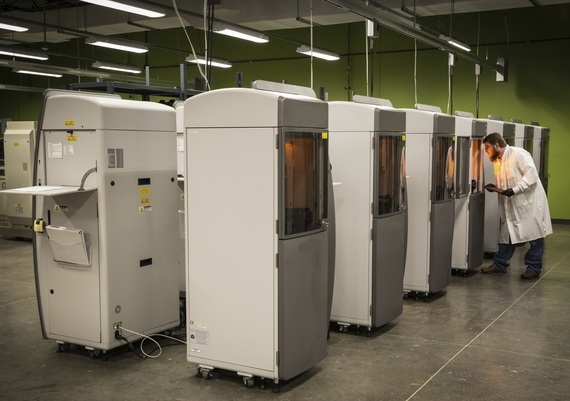
Industrial 3D Printers
Solution for every business !
While much attention has been focused on the consumer marketplace, consumer-grade printers are not suitable for large-scale production grade 3D manufacturing. They do not have the speed, facilities or robustness which are critical for industrial manufacturing.
Learn more about 3D Printing
Manufacturers have been using industrial 3D printers for more than thirty years. Originally, industrial 3D printers were used primarily for rapid prototyping and the manufacture of final products. Today, industrial 3D printers have moved beyond manufacturing constraints and they have become critical to the economic production of parts and machine components.
Some of the technologies in use today, such as fused filament fabrication (FFF), were in fact invented in the early 80s’ however the technologies and processes for additive manufacturing have evolved considerably since. Significant 3D printing technologies used in manufacturing and engineering today include stereolithography (SLA), selective deposition lamination (SDL), selective laser sintering (SLS) and selective heat sintering (SHS). These 3D printing processes and technologies have enabled users to overcome design complexity challenges, and they can all offer cheap mass production for various applications.
We have seen various industries ramp up their use of industrial 3D printers in recent years, including the aviation and automotive industries, and more recently the gas and oil industry; with regards to the latter, General Electric’s oil and gas division are using 3D printers to manufacture low-cost metal nozzles for turbines. Industrial 3D printers can of course do a lot more than this however; they have the potential to revolutionise all engineering and manufacturing applications, and it’s only a matter of time before this happens.
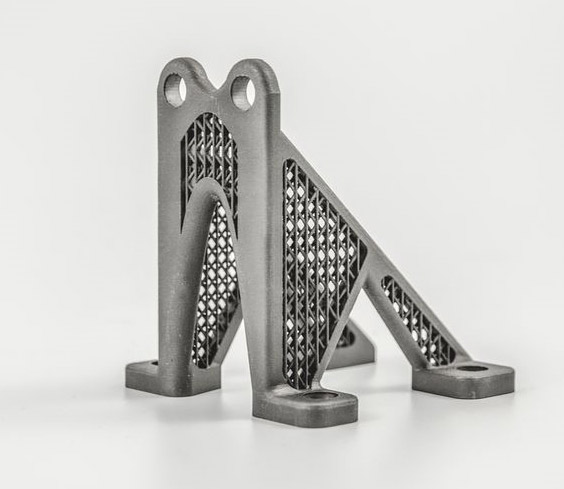
Metal 3D Printing
Combines high strength, corrosion resistance, and hardness. Used in a wide variety of manufacturing applications.
Learn more about Metal 3D printing
Metal 3D printing processes can be used to manufacture complex, bespoke parts with geometries that traditional manufacturing methods are unable to produce. Metal 3D printed parts can be topologically optimized to maximize their performance while minimizing their weight and the total number of components in an assembly.
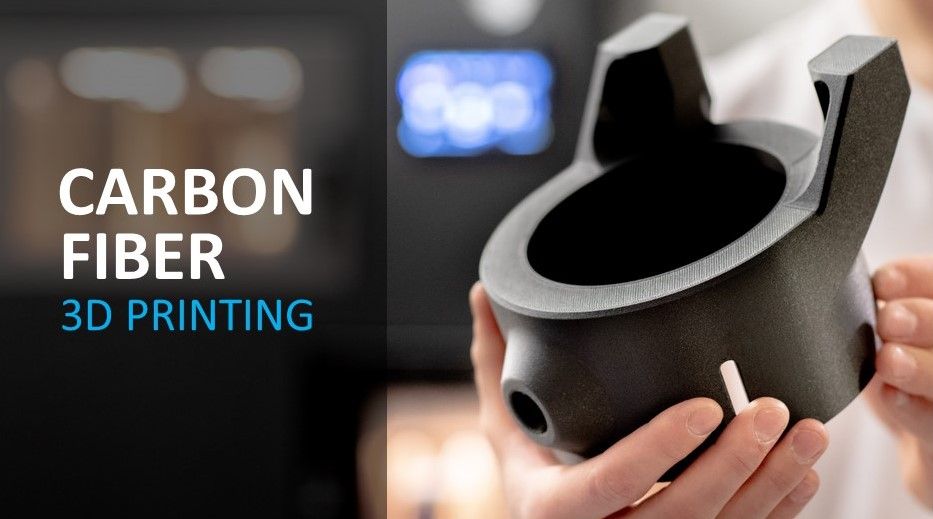
Carbon Fiber 3D Printing
What is carbon fiber 3D printing?
In 3D printing, carbon fiber is used to reinforce other materials, usually thermoplastics. Its main purpose is to make parts that are stronger and lighter, both properties proving to be very attractive for engineering applications in a wide range of industries.
Learn more about that Material
Produced for the first time by Joseph Swan in 1860, carbon fiber is made of a long chain of carbon atoms bonded together. The chain is usually between 5 to 10 micrometers in diameter and varies in length according to the application. Over the years, carbon fiber has become popular across many sectors because it offers interesting properties, including high stiffness, high tensile strength, low weight, high chemical resistance, high temperature tolerance and low thermal expansion. Pure carbon fiber is actually five-times stronger than steel and twice as stiff, yet lighter. As you can imagine, these characteristics make carbon fibers suitable for applications that rely on a material’s properties to optimize performance, which is particularly the case in sectors such as aerospace, automotive, military or civil engineering for example.
As some of you may already know, carbon fibers are rarely used on their own. They are usually combined with other materials to form what we call a composite material – referred to as carbon fiber reinforced materials in this particular case. These composites are made of a matrix material, usually a polymer – even though it is possible to use non-polymer materials such as ceramics – to which carbon fibers are added. The main benefit is you end up with a stronger, yet lighter plastic with an increased level of stiffness.
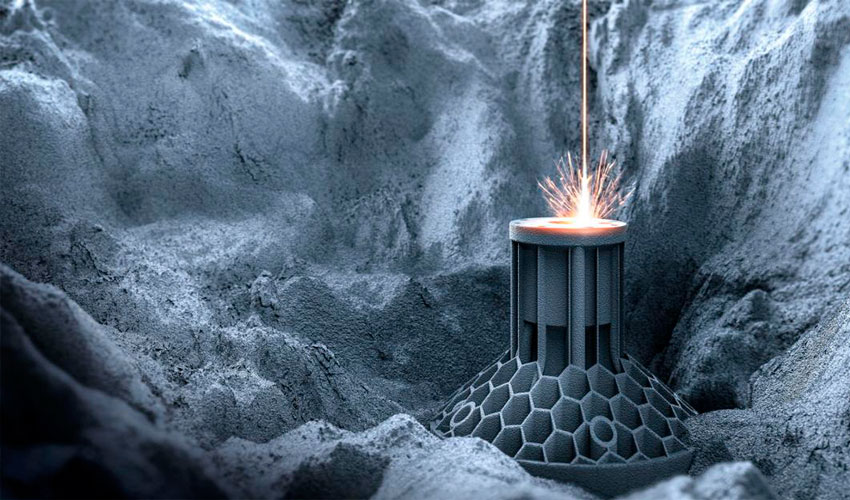
Laser Sintering 3D Printing
Selective laser sintering (SLS) is an additive manufacturing (AM) technology that uses a laser to sinter powdered plastic material into a solid structure based on a 3D model. SLS 3D printing has been a popular choice for engineers in product development for decades.
Learn more about that Material
First, a thin layer of the powder material is added to a building platform. There, a powerful laser beam melts the powder precisely at certain points specified by the computer-generated design data. Next, the construction platform is lowered and another layer of powder is added. The material is melted once again, which connects it to the layer below at the specified points. The additive technique was invented more than 30 years ago.